Acceleration is unlikely to be constant over an extended period, thus
it
forms either a short-lived fast varying signal or an alternating
signal.
Therefore one of the most important characteristics of an accelerometer
is
its frequency performance.
Basic Concepts
Acceleration = d2x/dt2 = dv/dt;
where velocity, v=dx/dt.
x is the linear displacement in metres and v is the
linear
velocity in metres per second.
In addition one can measure angular acceleration defined by
Ang_Accn = dw/dt where w (omega) is the angular velocity in rad/s.
For each of the axes in three dimensions, this corresponds to the three
linear
and three angular accelerations, for a total of six acceleration
components.
Typically angular acceleration is measured using linear accelerometers
at
know positions relative to the rotational axis of interest.
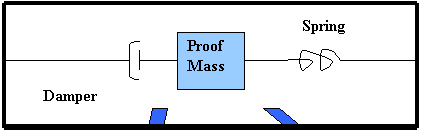
In general, accelerometers sense acceleration by using a proof mass or
seismic
mass, and by measuring the displacement of this mass.
An important parameter for accelerometers is
the noise power. Thisis actually its power
density spectrum - a measure of how the noise power contributed by
individual frequency components is distributed over the frequency
spectrum. It should be measured in watts/Hz; however the
accepted practice is to use amplitude-squared as the unit of
power. For electrical signals this gives units of volts-squared/Hz,
or more commonly expressed as volts/root-Hertz.
If you have any
questions or want further information,